New Books To Read in 2026

If you’re anything like most readers, your “to be read” list is already out of control and yet you’re still searching for the next book that will truly stay with you.
Every year, thousands of titles hit the shelves. But let’s be honest, only a handful are actually worth your time.
That’s exactly why we created this curated list of New Books to Read in 2026.
In this guide, you’ll discover the most anticipated releases, breakout debuts, and hidden gems across genres, from page turning thrillers and unforgettable literary fiction to powerful self help and culture shifting nonfiction. Whether you’re looking for your next weekend binge or a book that challenges the way you think, this list will help you choose smarter, not just more.
Because in 2026, reading isn’t about keeping up. It’s about reading what truly matters.
Tulip's Touch
SALIS MANIA CHOICE AWARDS 2026 NOMINEE
In the hyper-accelerated world of tech, timing is everything.
Sabitha Sriram’s Tulip’s Touch ambitiously attempts to ride the defining cultural wave of our era: Artificial Intelligence. With an earnest desire to cultivate a humane and reliable digital landscape, Sriram outlines how technology can bloom into a force for social good.
It’s a lovely, high-minded proposition. Yet, Tulip’s Touch suffers from the cardinal sin of modern media: it arrives a season too late.
The vast majority of Sriram’s ideas are already in motion across Silicon Valley. Reading them feels less like gazing into a crystal ball and more like reviewing last year's headlines. Had Sriram instead forecasted where AI will intersect with humanity over the next 3, 5, or 10 years, this book could have been a forward-looking masterpiece. Instead, it gets swept away by the very wave it hoped to master.

Beginning Middle End
From the beloved, award-winning author of the modern classics Lost Children Archive and Tell Me How It Ends comes her most powerful and page-turning novel yet: the tale of a mother and a daughter starting over, searching for a new story.
"A beautiful, maybe perfect, novel.” —Tommy Orange, author of Wandering Stars
This story begins when a mother and her daughter take off on a trip. It is a summer of rapidly changing winds, volcanic rumbles, and sudden tempests. They’ve landed in Sicily, near the ancient ruins where the mother’s grandmother worked long ago on an archaeological dig. The narrator’s marriage has collapsed, her mother is losing her memory, and her daughter is on the threshold of adolescence, starting to ask difficult questions and form complex memories. How do you begin again? the narrator wonders, pondering her family line. How do you begin again if you got the beginning wrong?
While the mother tries to figure out how to reconstruct their lives as a duo—cooking meals side by side, reading out loud to each other, playing chess, bickering and making up—her daughter takes the reins of the story, and their journey soon becomes a quest for origins, not just to the familial past across continents, languages, and generations, but also farther back, to a mythical and even geological past.
Beginning Middle End evolves into a road novel of exquisite tenderness, spanning four generations of women. In their travels through Sicily, mother and daughter cross paths with the island’s migrants, storekeepers, and elders, and also its volcanoes, its winds, and its waters. Weaving myths, ancient philosophy, and natural history with fleeting moments of contemporary life, the unforgettable characters in this novel take us on a journey across time, and confront some of life’s primary questions: How do stories shape our children’s memories and imagination? How do we situate ourselves deeply in the world while accepting our transience in it? How are a family’s memories made and what happens when they disappear?
Warm, funny, and poetic, this novel is an ode to imagination and possibility in dark times.

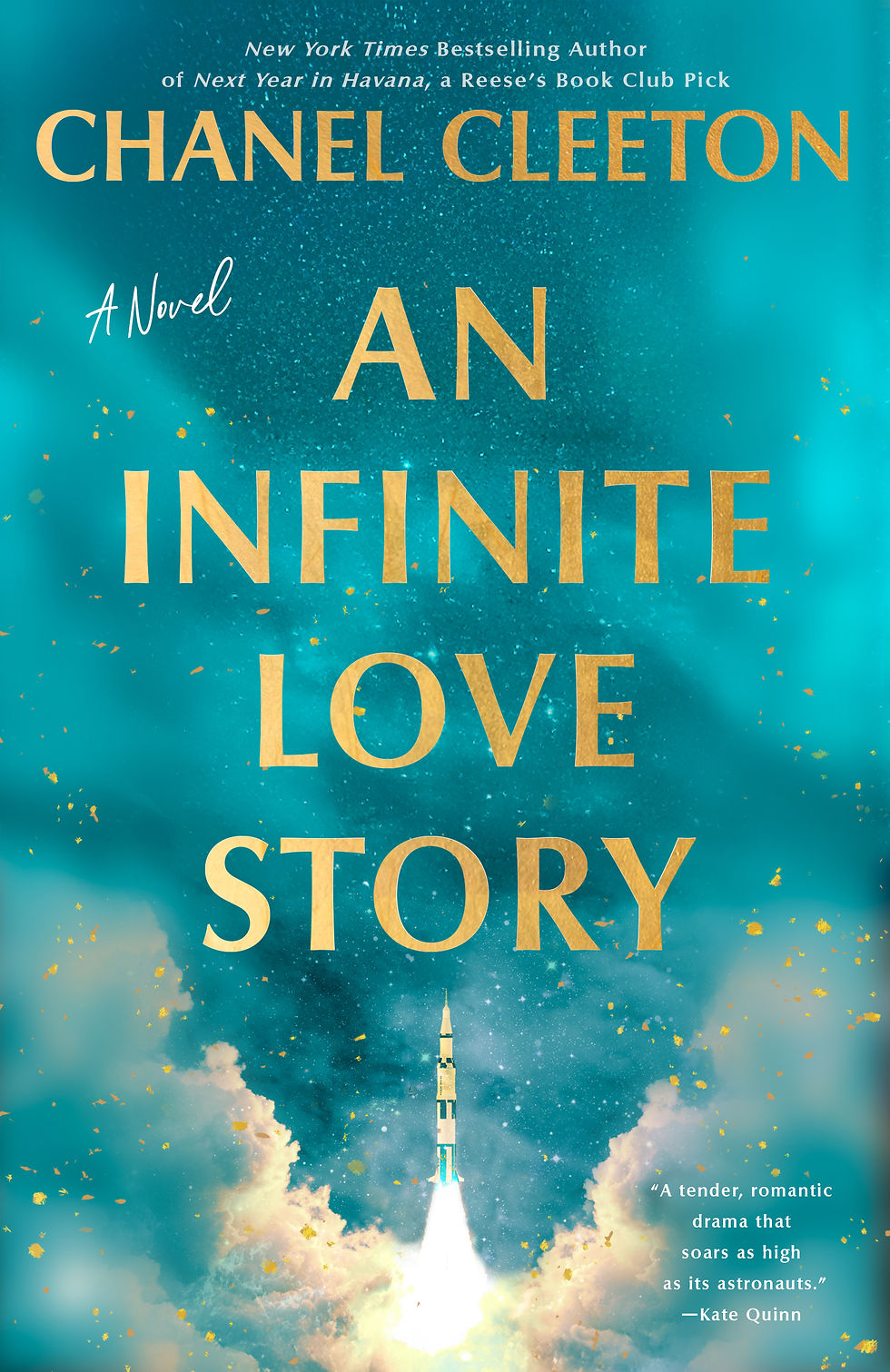
An Infinite Love Story
NAMED A MOST ANTICIPATED BOOK FOR SUMMER BY NPR, WOMAN'S WORLD, PARADE, AND BOOKBUB
“A sweeping romantic drama with a touch of magical realism. ...Cleeton's ability to pull readers in quickly and deeply through her storytelling makes her a go-to author for an immersive reading experience. ...Vivian and Joe's love is unforgettable, and so is Cleeton's writing.”
When an astronaut is lost in space, his wife relives their epic love as she attempts to unravel what truly happened to him, in this sweeping love story set against the backdrop of the 1960s Space Race, from the New York Times bestselling author of The Lost Story of Eva Fuentes.
When Joe Mitchell launches into space, the world is watching. It’s 1968, and the country waits with anticipation and excitement for another successful mission, another celebration as America sets its sights on the Moon. And then comes the knock at the door.
Joe Mitchell’s spacecraft has lost contact. He and his fellow astronauts onboard are feared to be dead. It’s his wife Vivian’s worst nightmare come to life, her grief suddenly taking center stage as the nation waits and mourns. In her quiet moments, Vivian relives their memorable story, unable to accept that this is the end to a love that felt as though it was written in the stars.
As the investigation surrounding Joe’s lost spacecraft intensifies and the mishap is written off as an operator error, Vivian is determined to clear her husband’s name and uncover the mystery of what happened in space. When someone starts sending Vivian messages—messages she believes only Joe could send—she begins to wonder if their love is stronger than space and time, and she’ll do whatever it takes to bring her husband back to her.
Not exactly Professional
SALIS MANIA CHOICE AWARDS 2026 NOMINEE
In Not Exactly Professional, the second installment of Ruchi Chandra Verma’s Singhania Brothers series, the high-stakes world of corporate enterprise is rendered with the glossy, addictive pull of prestige television.
Verma builds a remarkably authentic, lived-in universe which highlights the fact that big-company perks come attached to grueling, high-profile scandals.
Early on, the novel thrives. Fueled by richly human characters with clear motivations and genuine growth, the story maintains a brisk, binge-worthy momentum, a marked step up in craft from the series' debut.
Yet as the narrative hurtles toward its climax, its delicate equilibrium falters. Verma’s late shift into high-octane drama territory feels forced, undercutting the authentic romantic tension established earlier.
Still, for those drawn to the desi drama, Verma offers an engaging read.

Lady X
By Molly Fader
The search for a notorious vigilante exposes the secrets among three generations of women, from contemporary L.A. to gritty 1970s New York, in this propulsive novel hailed as “an unputdownable paean to female rage and retribution” by #1 bestselling author Jodi Picoult.
Los Angeles, 2024. After learning that her A-list actor husband sent explicit photos to multiple girls on social media, Margot Cooper runs away from the world—and the paparazzi—by fleeing to her childhood home with her teenage daughter in tow.
But home isn’t the sanctuary Margot was hoping for. In a cardboard box in the corner of the attic, she finds damning evidence of an infamous urban legend, the mysterious vigilante “Lady X”—including a blurry newspaper photo of a woman who looks an awful lot like Margot’s mother.
New York City, 1977. In the midst of an infamous summer, Ginger Daughtry and her two beloved roommates are able to shield one another from the chaos—until one of them is assaulted. Astounded by the lack of response from police, the young women decide to engage in some light payback, signing their handiwork as “Lady X.”
Soon copycats appear, and a movement inspired by acts of vandalism against terrible men spirals out of control, with criminals running amok under the guise of the enigmatic Lady X. When a body is found fallen—or pushed—from five stories high, the hunt reaches a boiling point.

Villa Coco
Andrew Sean Greer, Pulitzer Prize-winning author of Less, showcases his wit, sophistication, and deep knowledge of focaccia in this tale of a young man who takes an unspecified job with a charismatic elderly Baronessa at her crumbling villa in the Tuscan hills.
A MOST ANTICIPATED BOOK OF THE YEAR: People, TIME, Esquire, Oprah Daily, Lit Hub, Seattle Times
“No one writing in English is funnier or more charming than Andrew Greer. Every sentence in this novel sings.” —David Sedaris, author of Happy-Go-Lucky
“An absolute delight.”—Elif Batuman, author of Either/Or
“Such a sunny book.”—Kate Atkinson, author of Shrines of Gaiety
An aspiring archivist determined to begin a “serious” life after an undistinguished undergraduate career takes up residence in the Italian countryside. Here, he becomes the all-purpose assistant to the Baronessa, known to her friends as Coco, a defiantly youthful and naturally flamboyant woman of ninety-two. Amid a chaotic and colorful milieu of gin-swilling princesses, incomprehensible handymen, roaming boarhunters, nuns, and other local wildlife, our young man does his best to catalog the villa’s extensive collection of art and antiques—although he notices that things seem to go missing from right under his nose.
Despite himself, he tumbles into an affair with a married man, complicating his future plans considerably. And when the Baronessa loses someone close to her, he becomes an unwitting accomplice in the acceleration of Coco’s great and final plan: to locate the love of her life and be reunited before it’s too late. Told with the signature wit, charm, and humanity that made Less an international phenomenon, Villa Coco is a dazzling, sun-soaked ode to life itself, a meditation on how seriously we ought to take ourselves, and a bawdy Mediterranean ballad about becoming who we’ve always wanted to be.

Land
The award-winning, bestselling author of Hamnet and The Marriage Portrait returns with a soaring historical novel set in Ireland in the years before and after the Great Hunger.
“A breathtaking hymn to the sanctity of natural spaces, operating on timescales both intimate and geological. I finished Land moved not only by the vivid lives of its human characters, but the thrumming, gorgeous presence of its mosses, waters, winds, and skies.” —Daniel Mason, author of North Woods
On a windswept peninsula stretching out into the Atlantic, Tomás and his reluctant son, Liam, are working for the great Ordnance Survey project to map the whole of Ireland. The year is 1865, and in a country not long since ravaged and emptied by the Great Hunger, the task is not an easy one. Tomás, however, is determined that his maps will be a record of the disaster.
The British soldiers in charge are due to arrive any day, expecting the work to be completed, but Tomás is unexpectedly sent off course by an unsettling encounter in a copse. His life, and the lives of those of his family, will never be the same again. Liam is terrified by the sudden change in his taciturn father. What was it that caused such cracks to open in Tomás, and how is Liam, aged only ten, going to finish the mapping and get them both home?
Land is a novel about separation and reunion, tragedy and recovery, colonization and rebellion. It is a story of buried treasure, overlapping lives, ancient woodland, persistent ghosts, a particularly loyal dog, and how, when it comes to both land and history, nothing ever goes away. As spellbinding and varied as the landscape that inspired it, Land is, above all, a story of survival, for our times and for all time.

Looking Again
By Jerald Balasingh
SALIS MANIA CHOICE AWARDS 2026 NOMINEE
In the crowded field of modern self-help, where dense psychological treatises often demand a PhD to navigate, Jerald Balasingh’s Looking Again offers a refreshingly unpretentious approach. It’s like a long walk with an old friend, offering insights without overwhelming you. Balasingh takes on a daring task: distilling the vast concepts of behavioural economics and stoicism into digestible, fictional vignettes. There are echoes of Daniel Kahneman’s Thinking Fast and Slow throughout the book, but Balasingh successfully translates the tension between intuition and reflection into a more relatable language.
However, for a book so focused on relatability, Looking Again occasionally falters in execution. While the prose is remarkably clear, the narrative vehicles Balasingh chooses sometimes clash with his “everyman” philosophy. He frequently shifts from the power of the mundane to the “once-in-a-lifetime” spectacle, resulting in stories that feel too niche or unnecessarily complicated for the simple truths they aim to convey.
Balasingh is clearly a skilled writer who can move an audience, but he often chooses a winding path that diminishes the impact of the destination.
Ultimately, Looking Again is a work of undeniable skill that suffers from a slight identity crisis. It is a charming and thoughtful collection that succeeds in simplifying the complex, even if it occasionally complicates the simple.

The Delhi Gambit
By Dr. Jawahar Surisetti
SALIS MANIA CHOICE AWARDS 2026 NOMINEE
In the quiet corridors where power is truly brokered, the most lethal weapons are no longer forged in foundries but curated in the air-conditioned silence of the Situation Room.
Dr. Jawahar Surisetti’s The Delhi Gambit arrives as a sharp-elbowed rejoinder to the traditional espionage novel, trading the predictable heat of border skirmishes for the cold, calculated friction of psychological warfare.
The story seizes the reader immediately, propelled by a setting that feels deeply lived-in and authentic, far removed from the glossy, sterile backdrops of lesser thrillers.
Surisetti’s characters are the true “flesh and blood” of the operation, rendered with clear motivations and a palpable sense of growth that elevates them above the usual genre ciphers.
It is a work that demands an active intellect, frequently nudging the reader toward a search for political terms and historical events that might elude the casual observer. This demanding quality serves as a hallmark of its depth.
By focusing on how countries now war with words rather than guns, the novel masterfully highlights the role of influential politicians who ride waves of global uncertainty to keep the public calm, neutralising threats in the shadows that the citizenry isn’t even aware of.
Perhaps most refreshing is the narrative’s pivot away from the shopworn villainy of regional neighbours like Pakistan or China; instead, it finds a sophisticated friction in a political chess match between India and the United States that views its own global dominance as a form of divinity.
Despite its ambitious narrative, Surisetti’s gambit occasionally trips over its own overextension. The story, which starts with such urgency, suffers from a middle that sags under the weight of its own strategic density.
While exploring “fictional realities” as a counter to national threats is intellectually stimulating, the prose sometimes feels less like a pulse-pounding thriller and more like a white paper on business coercion and legal warfare.
The emphasis on how opposition manipulation and media disinformation are elements of a single intelligence operation is brilliantly conceived, but the execution sometimes prioritises the lecture over the legend.
The pacing flags as the book delves into the labyrinthine world of political theory, occasionally slowing the blood flow of a story that initially promised a sprint.
For a book so attuned to the psychological nuances of power, it sometimes forgets that even the most brilliant strategist needs a clear path through the woods.
The intellectual rigour is undeniable, but it occasionally comes at the expense of the narrative drive, leaving the reader to navigate a dense thicket of economic retaliation and diplomatic manoeuvring that, while realistic, threatens to stall the very engine it aims to fuel.
Ultimately, it is a sophisticated, uneven exploration of modern statecraft that proves the pen or perhaps the server is indeed mightier than the sword, provided one has the patience to see the match through to its endgame.

Good to Great
By Jim Collins
The Challenge
Built to Last, the defining management study of the nineties, showed how great companies triumph over time and how long-term sustained performance can be engineered into the DNA of an enterprise from the very beginning.
But what about the company that is not born with great DNA? How can good companies, mediocre companies, even bad companies achieve enduring greatness?
The Study
For years, this question preyed on the mind of Jim Collins. Are there companies that defy gravity and convert long-term mediocrity or worse into long-term superiority? And if so, what are the universal distinguishing characteristics that cause a company to go from good to great?
The Standards
Using tough benchmarks, Collins and his research team identified a set of elite companies that made the leap to great results and sustained those results for at least fifteen years. How great? After the leap, the good-to-great companies generated cumulative stock returns that beat the general stock market by an average of seven times in fifteen years, better than twice the results delivered by a composite index of the world's greatest companies, including Coca-Cola, Intel, General Electric, and Merck.
The Comparisons
The research team contrasted the good-to-great companies with a carefully selected set of comparison companies that failed to make the leap from good to great. What was different? Why did one set of companies become truly great performers while the other set remained only good?
Over five years, the team analyzed the histories of all twenty-eight companies in the study. After sifting through mountains of data and thousands of pages of interviews, Collins and his crew discovered the key determinants of greatness -- why some companies make the leap and others don't.
The Findings
The findings of the Good to Great study will surprise many readers and shed light on virtually every area of management strategy and practice.
The findings include:
Level 5 Leaders: The research team was shocked to discover the type of leadership required to achieve greatness.
The Hedgehog Concept (Simplicity within the Three Circles): To go from good to great requires transcending the curse of competence.
A Culture of Discipline: When you combine a culture of discipline with an ethic of entrepreneurship, you get the magical alchemy of great results. Technology Accelerators: Good-to-great companies think differently about the role of technology.
The Flywheel and the Doom Loop: Those who launch radical change programs and wrenching restructurings will almost certainly fail to make the leap.
Some of the key concepts discerned in the study, comments Jim Collins, "fly in the face of our modern business culture and will, quite frankly, upset some people.”
Perhaps, but who can afford to ignore these findings?

This Story Might Save Your Life
By Tiffany Crum
Benny Abbott and Joy Moore host one of the most beloved podcasts in the world. Each week, they delight listeners with a different “against all odds” survival story, gleefully finding the weird, life-affirming humor in near-death experiences. Since their first episode on Joy’s experience with severe narcolepsy, they’ve been the best friends everyone wants to befriend—and thanks to the meticulous management of Joy’s husband, Xander, they’ve built a lucrative empire.
The problem is, their next survival story may be their own. When Benny arrives at Joy and Xander’s one morning to record, he finds shattered glass and an empty house. The one clue shedding light on the couple’s disappearance is the incomplete, previously unseen first draft of Joy’s memoir. Benny will stop at nothing to find them, even as the police zero in on him as their prime suspect.
Millions of devoted listeners think they know the “real” Benny and Joy. But as the hours tick by, and the odds seem increasingly stacked against Joy and Xander being found alive, not even the most devoted fans could guess the terrible secrets their favorite famous BFFs have hidden from the world—and from each other.

Our Perfect Storm
Best friends have one week in paradise to fix their friendship or fall apart in this heart-stopping, utterly romantic new novel from the #1 New York Times bestselling author of Every Summer After and One Golden Summer.
Frankie and George have been best friends since they were eight years old. Both passionate, impulsive, and headstrong—they’ve always clashed . . . and come back together. Until now. It’s the eve of Frankie’s wedding weekend, and she doesn’t know where they stand or even if George will show up as her best man.
Then, at the start of the festivities, in walks George. For one glorious evening, surrounded by her loved ones, Frankie’s life is finally perfect. But it all comes crashing down when her fiancé dumps her the next morning, leaving only a note as an explanation.
Crushed and confused, Frankie returns to her family’s home to wallow. But George has a different idea and a plan for healing Frankie’s broken heart. He wants her to go on her honeymoon. With him. For one week, to the lush rainforests and misty beaches of Tofino.
Frankie agrees, seeing the trip for what it really is: one last chance to repair their friendship. Even if it means unearthing secrets and long buried feelings neither knows how to handle. Even if it means falling apart for good.

In Her Own League
By Liz Tomforde
As the first female team owner in Major League Baseball, Reese Remington has spent her entire life preparing for this role. With a sharp mind and years of experience working behind the scenes, she's more than qualified. But the public only sees a woman in a man's world — not the person who's earned their place on the field. Under constant scrutiny and pressure to prove herself, Reese can't afford distractions.
Especially one that comes in the form of the team's tempting field manager who questions her every decision.
Emmett Montgomery is a former All-Star turned coach who treats his players like family and the field like home. After years of running the team his way, the last thing he wants is a new boss, let alone one who seems ice-cold and laser-focused on business. But forced to spend long hours - and too many away games - side by side, he begins to see the fire beneath Reese's control, the heart behind her ambition, and the unwavering determination to prove herself.
When heated banter turns into sizzling chemistry, professional boundaries blur and the spark between them becomes impossible to resist. But Reese is constantly reminded of how many people are waiting for her to fail, and the safest move is to keep Emmett at arm's length - for the sake of the team, the season, and her career.
But keeping their distance is one game neither of them can seem to win.

Lifequake
By Tarini Mohan
SALIS MANIA CHOICE AWARDS 2026 NOMINEE
Tarini Mohan’s Lifequake presents itself as a memoir of life-altering disruptions, neatly divided into before and after. It succeeds largely on the strength of its emotional candour. The book navigates loss, recovery and the delicate process of rebuilding with a sincerity that feels largely unfiltered. Mohan prioritises preserving the immediacy of experience over crafting a polished narrative, which gives the work its quiet power.
At its best, Lifequake serves as a testament to the enduring nature of human connection. The author repeatedly emphasises the importance of real-life relationships, friends, family and support systems, not just as comforting but essential for survival. These reflections are among the book’s most persuasive elements, highlighting how recovery is rarely a solitary journey. Equally compelling is Mohan’s assertion that “good luck” is not simply stumbled upon but, in some measure, constructed through resilience and intention. This hopeful proposition lends the memoir a steady, if understated, optimism.
Mohan’s personal voice shines through in the way she presents herself. Her earnest, reflective and sometimes disarmingly open tone permeates the narrative, making it feel inhabited rather than performed. In its most vivid passages, particularly those rooted in grief and memory, the prose creates a sense of proximity, as if the reader is not just observing events but experiencing them alongside the author.
Yet the very qualities that make Lifequake intimate also account for its limitations. The book often leans more towards narration than conversation, presenting a sequence of events rather than a sustained, probing dialogue with the reader. At times, it resembles a personal diary, honest and immediate, but occasionally lacking the structural refinement that could transform lived experience into deeper, more universal insight. Certain sections feel included out of completeness rather than necessity, which can give the narrative an uneven rhythm.
Furthermore, while the memoir gestures towards larger ideas such as grief, healing and the importance of reading and reflection, it rarely explores them with sustained depth. A more layered engagement, whether through introspection or external context, might have enriched the text and expanded its emotional reach. As it stands, some themes feel introduced but not fully developed, leaving the reader wanting a more rigorous exploration.
Still, Lifequake endures in the mind not because of its structure, but because of its feeling. Mohan’s willingness to lay bare her experiences gives the book a lingering resonance. Ultimately, it is a reminder of life’s unpredictability that everything can change in an instant and of the possibility, however fragile, of beginning again by accepting what cannot be undone.
For all its imperfections, the memoir carries a quiet, persistent sincerity. It may not always achieve the depth it reaches for, but it leaves behind something perhaps just as valuable: the sense that one has been trusted with a life honestly told.

The Store of Life
By Shruthi Harikrishna
SALIS MANIA CHOICE AWARDS 2026 NOMINEE
Shruthi Harikrishna’s The Store of Life is written with a clear intention: to make nonfiction feel welcoming to readers who usually avoid it. The book builds its central idea around a familiar experience, shopping, and uses it to explain how we choose habits and make everyday life decisions. By comparing life to a store where we constantly pick and discard behaviors, Harikrishna gives readers a framework that feels intuitive rather than abstract. This metaphor runs consistently through the book and helps keep the ideas grounded and easy to follow.
One of the book’s strongest qualities is its accessibility. The language is simple, the chapters are short, and the ideas are broken down in a way that never feels heavy. The illustrations play an important role here. Instead of feeling ornamental, they actively support the concepts and make the strategies feel less intimidating and more engaging. The tone is encouraging rather than instructional, which makes the book especially suitable for beginners. A young reader, or someone new to self-help and personal growth, could read this book and immediately start applying its ideas without feeling overwhelmed.
Harikrishna also shows restraint in what she chooses to include. Rather than presenting dozens of theories or referencing multiple sources, she focuses on a limited set of practical strategies that are already well established. For readers tired of consuming endless motivational content online, this approach may feel refreshing. The book asks for attention, but not endurance. Each chapter offers something concrete, making progress feel achievable instead of aspirational.
That same simplicity, however, may limit the book’s appeal for experienced nonfiction readers. Those familiar with personal development literature are unlikely to encounter ideas they have not seen before. The metaphors remain straightforward, and the insights prioritize clarity over depth. This does not weaken the book so much as define its audience more narrowly.
The Store of Life works best as an entry point. It is a gentle introduction to self-improvement for readers who want results without complexity. It may not challenge seasoned readers, but for newcomers, it offers a calm, friendly, and well-organized place to begin.
