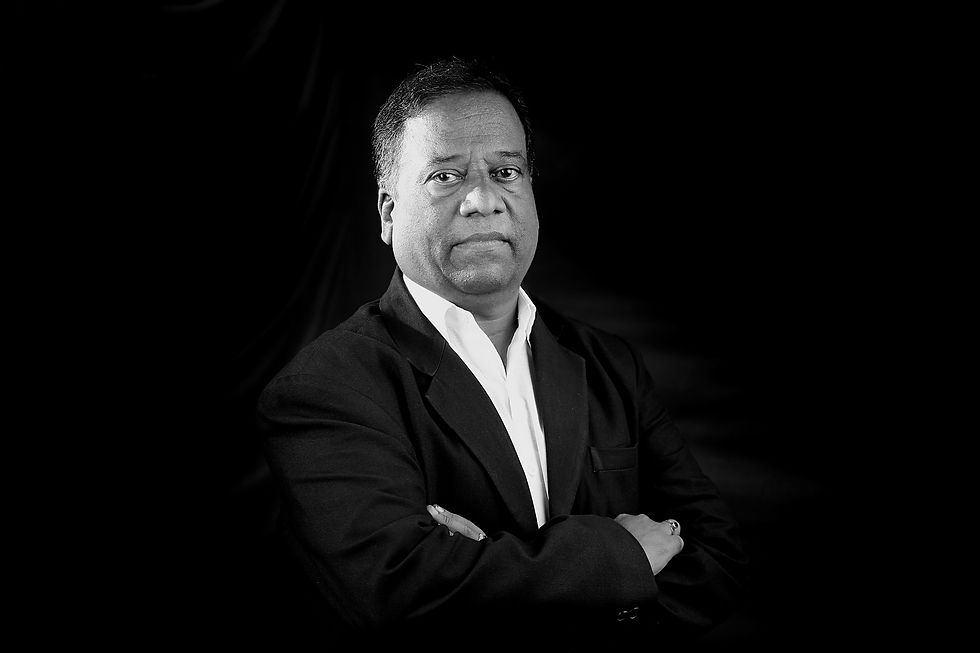
Echoes of Aditya Hegde

In an era consumed by frantic speed and relentless noise, Aditya Hegde’s Echoes of Sonder offers a quiet sanctuary of lived philosophy, pulling existential truths onto midnight balconies and rain-slicked train platforms to tenderly remind us that none of us are carrying our stories alone. Step inside our exclusive cover story interview with Aditya Hegde to discover how he transforms the ache of modern life into an art of radical presence, compassion, and shared humanity.
Salis: If Echoes of Sonder were a physical room, what would it look like, smell like, and sound like?
Aditya: If Echoes of Sonder were a physical room, it would be a room with a large window through which you could see the sky and a distant horizon. Two walls would be lined entirely with books, while another would be covered with art—paintings, photographs, perhaps a few things collected from places and moments that meant something.
There would be a large, slightly lived-in desk with a laptop, notebooks, and enough space for writing and painting. A comfortable couch would sit somewhere nearby, the kind of place where a conversation could begin at midnight and nobody would feel the need to check the time.
There would be a guitar and a keyboard in the room, with calming music playing softly in the background. The lights would be dim and warm, never bright enough to demand your attention.
And it would probably smell like books, green tea, and the faint scent of rain coming through an open window.
More than anything, it would be a room where you could think without being hurried.
A room where you could read, create, talk, sit quietly, look at the horizon—and perhaps, for a little while, hear your own thoughts clearly.
Because Echoes of Sonder isn’t a place that asks you to escape life. It asks you to notice it.
Salis: “Sonder” is such an evocative word. Do you remember the exact moment or place where you first truly felt it?
Aditya: I don’t think sonder arrived as one dramatic revelation. It accumulated slowly.
It happened while travelling through unfamiliar cities, watching strangers disappear into train stations, taking long walks, sitting in cafés, or simply being in nature and observing without trying to name what I was seeing. I would look at people going about their lives and suddenly realise that every person I passed was carrying dreams, heartbreaks, fears, childhood memories, unfinished conversations, and invisible battles that I would never fully know.
Everyone was living a life as vivid and complicated as my own.
That realisation was strangely comforting.
It made the world feel infinitely larger, while making my own problems feel beautifully smaller. There was something humbling about understanding that I was not the centre of the story, but simply one small consciousness among billions—each person carrying an entire universe within them.

Salis: Existential philosophy can feel heavy, but Echoes of Sonder feels like a sanctuary. How do you translate grand, complex philosophy into something tender and accessible?
Aditya: I’ve never believed philosophy belongs only inside universities.
The greatest philosophers weren’t trying to impress people. They were trying to understand what it means to be alive.
Instead of explaining existentialism through definitions, I write about missing a friend, sitting alone on a balcony during the rain, watching a tree grow through changing seasons, or saying goodbye to someone you love. Those ordinary moments already contain philosophy.
People rarely fall in love with ideas.
They fall in love with stories that quietly reveal those ideas.
Salis: What is one timeless truth from an ancient or modern thinker that helps you navigate the noise of modern life?
Aditya: Viktor Frankl’s belief that between stimulus and response there is a space—and in that space lies our freedom.
The world constantly asks us to react.
Echoes of Sonder reminds me to pause first.
That pause is where agency begins.

Salis: If you had to summarise the soul of Echoes of Sonder in just three words, what would they be?
Aditya: Curiosity. Presence. Compassion.
Salis: Walk us through your ideal writing routine. Coffee or tea? Silence or a specific playlist?
Aditya: Green tea. Always. I usually begin with silence because silence lets me hear the first honest sentence. Once the rhythm appears, instrumental music takes over—often gentle piano, ambient soundscapes, or rain. Writing rarely starts with words. It begins with observing. A walk. A conversation. A photograph. The moon. The smell of wet earth. Eventually, one small moment refuses to leave my mind. That’s usually the essay asking to be written.
Salis: When you sit down to write or curate an essay, how do you know a story is finished?
Aditya: When I can bring in hope or light into the story. Early drafts often try to explain everything. The final version leaves enough unanswered that the reader becomes a collaborator rather than an audience. If someone finishes an essay with their own memories rising to the surface, then the story has done its job.
Salis: What is the most unexpected place you’ve ever found inspiration?
Aditya: Waiting. Airports. Hospitals. Train stations. Traffic lights. Places where nobody wants to be often become places where everyone quietly reveals who they are. Those spaces have taught me more about humanity than many books.
Salis: How do you choose which voices and perspectives to feature?
Aditya: I try to feature perspectives that increase understanding rather than certainty. Echoes of Sonder isn’t interested in winning arguments. It’s interested in expanding conversations. If a voice helps us see another human being with greater compassion, it belongs here.
Salis: Is there an essay that almost didn’t get published?
Aditya: Live Live Love. It carried people I loved, people I lost, and versions of myself I had spent years trying to understand. Publishing it felt less like releasing an essay and more like opening a window. I almost kept it private because vulnerability always carries a risk. But I realised that what feels most personal is often what becomes most universal.
Salis: A book that changed how you view other people?
Aditya: Man’s Search for Meaning by Viktor Frankl. It taught me that you never truly know what another person has survived.

Salis: Your favourite quiet corner?
Aditya: My room. It’s probably the quietest corner of the world for me, not because the world outside disappears, but because I can finally hear myself clearly.
Salis: A question you wish people asked themselves more often?
Aditya: “Can I feel like home within myself?” I think we spend so much of our lives searching for home in people, places, relationships, achievements and identities that we sometimes forget to ask whether we feel at home within our own existence.
Salis: Three thinkers for dinner?
Aditya: Ram Dass. Alan Watts. Jesus. I imagine I’d spend most of the evening listening.

Salis: Your ritual when you feel disconnected?
Aditya: I stop consuming. I go for a walk without headphones, sketch, watch the moon if it’s visible, write without intending to publish anything, and sometimes simply sleep. I try to return to myself before trying to figure myself out. Presence returns long before certainty does.
Salis: A mundane detail you find endlessly fascinating?
Aditya: I can’t think of anyone who has ever looked at the stars and thought, “That is ugly.” There’s something beautiful about how universally they make us pause.
Salis: Your current soundtrack?
Aditya: What Sarah Said by Death Cab for Cutie. Because of what the song says about love, mortality, and the strange intimacy of witnessing someone you love move toward death. There’s a line in it that has stayed with me, the idea that love is, ultimately, being there to witness someone’s most human moments, including their last one. It’s a painful thought, but also a deeply beautiful one.

Salis: In a digital world designed for speed, how does Echoes of Sonder invite people to slow down?
Aditya: It refuses urgency. It doesn’t chase trends or outrage. It offers long sentences, quiet photographs, thoughtful pauses, and essays that ask readers to linger instead of consume. In a world competing for attention, slowing down becomes a form of resistance.
Salis: Freedom versus responsibility?
Aditya: Freedom without responsibility becomes isolation. Responsibility without freedom becomes an obligation. The healthiest societies are built by people who freely choose to care for one another.
Salis: Biggest misconception about the examined life?
Aditya: People think an examined life means having answers. I think it’s about asking better questions. It’s less about certainty and more about curiosity.
Salis: Is empathy innate or built?
Aditya: Both. We may be born with the capacity. But life determines whether we strengthen or neglect it. Empathy grows every time we become genuinely curious about someone else’s story.
Salis: What has running Echoes of Sonder taught you about yourself that you didn't know before?
Aditya: I started writing Echoes of Sonder to understand myself; to make peace with some of my own thoughts. In many ways, I treated it like a journal, except I was leaving the pages open for anyone who might find something of themselves in them. Some of my essays have answered questions I didn’t even know I was asking. And perhaps that is what Echoes of Sonder has taught me most about myself: that I often write not because I have something figured out, but because I am still trying to understand it. It has become less of a platform and more of a conversation with the parts of myself that are still learning.
Salis: If readers leave with one realisation?
Aditya: That they are not alone. Not in grief. Not in confusion. Not in wonder. Not in hope. Someone, somewhere, has stood beneath the same sky asking the same questions.
Salis: What’s next?
Aditya: I’m increasingly interested in conversations that sit at the intersection of philosophy, art, architecture, memory, travel, and everyday life. Not philosophy as abstraction, but philosophy as something lived—in cities, homes, friendships, rituals, photographs, and quiet moments that most people overlook. The next chapter of Echoes of Sonder is less about finding new answers and more about seeing familiar questions through fresh eyes.
Salis: Finally, looking at the stranger sitting across from you, what story do you imagine they carry?
Aditya: I imagine they’ve survived something they rarely speak about. I imagine there’s someone they still miss, a younger version of themselves they occasionally mourn, a dream they quietly protect, and a future they’re hoping is kinder than their past. Most strangers aren’t strangers for very long. Given enough time, honesty and compassion, every life begins to sound strangely familiar. And perhaps that’s what Echoes of Sonder has always been trying to say, that beneath our different names, languages and circumstances, we are all carrying variations of the same human story.